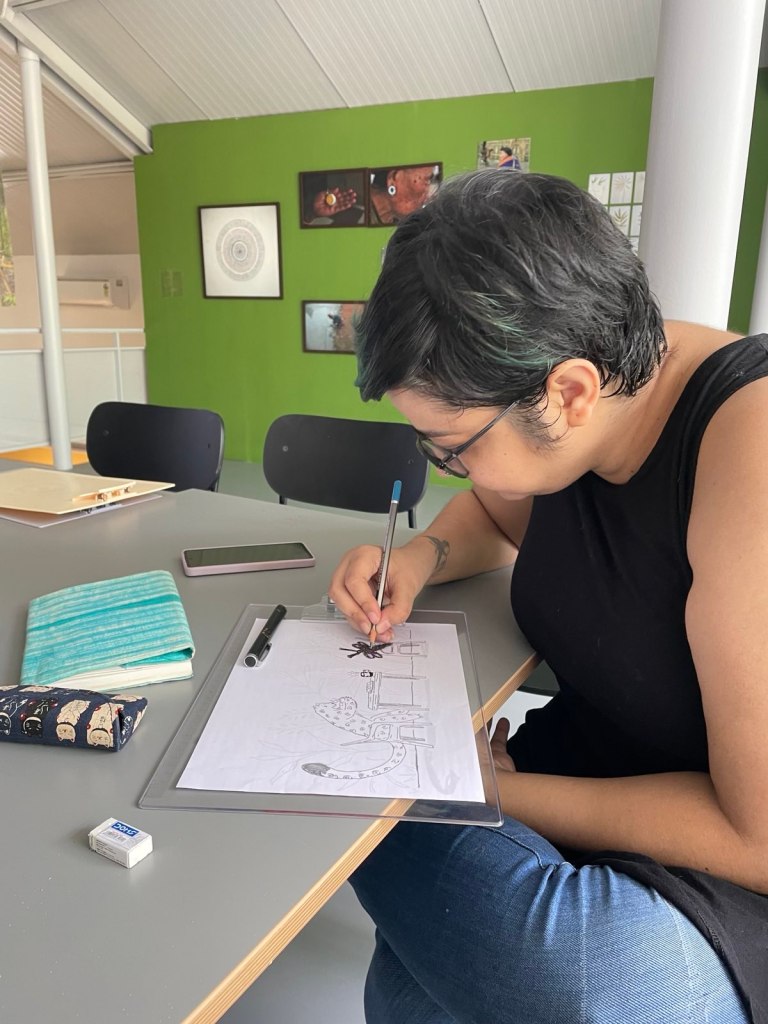
Srinidhi writes on sexuality, gender, disability and technology. She writes to share experiences from her work, to think through new ideas emerging in these areas and to build connections between gender, disability, sexuality and technology. She has been writing for national and international news platforms and organisations for the past decade.
Sexuality
- Reimagining Sexuality Education for Youth with Disabilities in Reproductive Justice: Recalibrating the SRHR Agenda For Arrow For Change
- Maybe we can talk about this next time we meet? Stories about sex, relationships and consent For Plan International by Srinidhi; Illustration, Art Direction by Sonaksha
- To keep children safe, talk to them meaningfully about sexuality For Indian Express by Priyangee Guha and Srinidhi
- Is ‘Good Touch’ and ‘Bad Touch’ an Unhelpful Shortcut to Teaching Kids about Consent? For Agents of Ishq
- Things Young Men Say to Me During Sex-Ed Workshops For Agents of Ishq
Feminist internet
- Gender IT edition: Global Attention To Technology-Facilitated Gender-Based Violence (TFGBV): Feminist Perspectives. This edition focuses on research done by researchers part of the Feminist Internet Research Network (FIRN) that attempts to understand Online Gender Based Violence (OGBV) in an expansive way by showcasing interconnections of technology, gender and our rights. It was co-edited by Srinidhi and Tigist.
- Why feminist research is necessary to address technology-facilitated gender-based violence: Recommendations and way forward For GenderIT.org
- Discussing Ethics of Care, Intersectionality and Power Dynamics in the Feminist Research Work For GenderIT.org
- EROTICS Regional Survey learnings (2): Understanding access and expression, and negotiating differences for GenderIT.org
- EROTICS Regional Survey learnings (1): Reflections on feminist internet research design for GenderIT.org
Disability
She wrote a column for FirstPost called Bodies and Minds that looked at the often ignored intersection of gender and disability. Some of the highlights from the column are below:
- On the beauty of disabled friendships: Navigating an ableist world with people who make you feel safe and seen
- For deafblind individuals in India, grappling with twin challenges of stereotypes and inaccessibility hinders true progress
- For people with psychosocial disabilities and mental illness, medical gaslighting often mars access to healthcare
- In discussing accessibility solely through the disability lens, we limit who benefits from access
- To challenge ableism that manifests in social justice movements, intersectional understanding of disability is key
- Amid pain awareness month, reflections on the medicalisation of disability and the constant search for ‘cures’
- Understanding and unlearning ableism is an ongoing process and one we must work on day-to-day
- The value of ‘crip time’: Discarding notions of productivity and guilt, to listen to the rhythms of our bodies
- In a world that often interprets ‘care’ as ‘burden’, interdependence should be valued beyond disabled community
- ‘Faking well’: Notes on navigating spaces, gatekeeping people with disabilities, and asking for help
Other pieces on disability
- A personal essay asking the question, who counts as disabled for Insights
- Why Deny the Disabled Population Digital Access? for The Quint
- Why Haben is a must read/listen for GenderIT.org
- Inclusion, mobility and connection: diverse uses of mobile phones for women with disability for GenderIT.org
- I’ve been in pain for two years, but I still struggle to accept that it’s ‘real’ for Skin Stories
- In Sangli, love and partnership in the lives of three couples with disabilities for Skin Stories
PUBLISHED RESEARCH
In this chapter, the authors explore contemporary examples of digital organising for health and well-being in India, Pakistan, and Sri Lanka. Through the lens of helplines as locations of care and advocacy, the authors examine how feminist organising on the Internet is deeply tied to online and offline advocacy on these issues. The chapter also provides insight into the role of intersectional politics with regard to information, processes, ways of working, presentation, and dissemination in these initiatives. These interviews with feminists from South Asia provide an overview of online support mechanisms and gaps and fault lines in feminist organising.
White Paper – Disability, Equity, Justice
To capture the full data from the consultations, conducted for Civil 20 India’s Disability, Equity, Justice Working Group in 2023, with the participation of over 2,500 persons with and without disabilities, nonprofit organisations, Organisations of Persons with Disabilities, disability rights experts, officers from multilaterals and disability rights allies from across 35 countries, a white paper was drafted.
Designing and coordinating regional research on gender, sexuality, internet in South Asian countries, April 2019 to September 2020
Managed and supported researchers from three South-Asian countries in an Exploratory Research on Sexuality and the Internet. A special focus was provided to the research in Nepal that focussed on women with disabilities and their usage of the internet for self-expression. Regional report
You can reach out to her for more writing samples or to commission her to write on any of the above topics.
 Srinidhi Raghavan